
Prepping for IBJJF Worlds pt. 1
or any Gi Jiu Jitsu Tournament

Everyone who competes or trains gi jiu jitsu knows that when April rolls around each year, the final 8 week push to IBJJF Worlds is officially on.
Eight weeks before a major tournament is a preparation benchmark in most combat sports, but particularly jiu jitsu. It represents the appropriate amount of time to amp up the intensity of your training, see results from off-the-mats strength and conditioning, and gives you just enough time to modestly manipulate your weight for your desired weight class.
Whether you’ve made plans to compete already, or are putting things together as you go (not recommended), I’ve compiled this guide to help you organize your off the mat training.
If you’re just starting to assemble a plan, then you’ve come to the right place. If you’re already working off a plan or program, I welcome you to use this guide as an audit.
In part I, we’ll address two of the most important factors in your success with a strength and conditioning program for jiu jitsu: overall planning and strength training.
In Part II, we’ll tackle conditioning methods for jiu jitsu, as well as power training, and we’ll comment on weight cuts. If you need help with any of this more immediately, I invite you to reach out to us today.
HAVING A PLAN
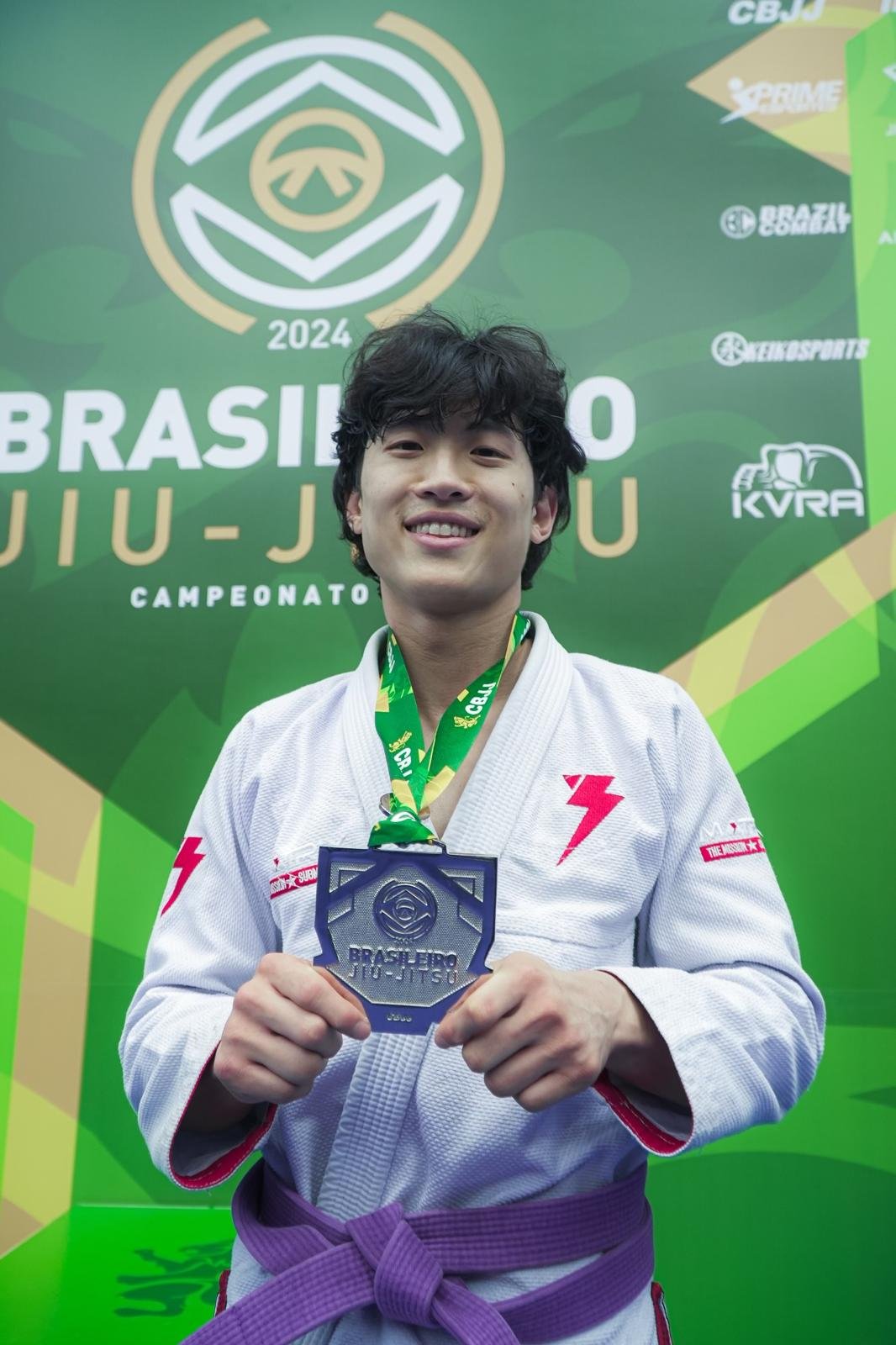
DiSalvo Performance Training alum Robin Hwang podiuming at Brazilian Nationals/Brasileros in 2024
This may seem unnecessary to say, but I can assure you that it’s not. In order to succeed off the mats and in any strength and conditioning program, you must have a plan. That plan doesn’t even need to be sophisticated or professionally vetted – it just needs to be written down on paper or your phone, and exist for the purpose of accountability. Without the simple act of knowing what you’ll be doing each day, you’ll be more likely to skip or alter your days based on how you feel, bad mental days, or even on a whim.
For example: you wake up feeling overwhelmed by whatever work obligation you have. If you know that you have a gym session scheduled, and it’s purposely put there to fit into the wider scheme of your week, you’ll be less likely to skip it if you’re feeling stressed or overwhelmed.
On the flip side, if you have an important recovery day, you won’t be as likely to accept an invitation to a 2-hour open mat at a new academy where everyone wants to try and submit the new guy (please be smart).
Accountability and predictability are big factors in success, and having something written down helps.
To take this a step further, I would indeed use a strength and conditioning professional to vet this or write your plan for you. People without much experience doing this tend to under or overdo their gym work, and having someone to guide you will be an asset.
STRENGTH
Modern jiu jitsu and competition dictate that you need to prepare yourself like a real athlete. Whether you train twice per week on the mats and compete once or twice every few years, or if you’re training nearly every day and compete a dozen times per year, you are an athlete all the same.
Athletes in all sports who wish to stay competing will all put themselves through some type of strength training. Jiu jitsu is no different.
Important note: before you read the advice below, remember that it is written for someone competing in the next 2 months and is not necessarily long-term advice. Again, the key consideration for this article is that you’re talking about an 8 week strength training program – not one that is meant to be kept up year over year, month to month, week to week. So please read the below advice with that mind.
For the purposes of getting someone the most essential information, I’ll separate my advice into two camps:
Those new to lifting, those who are inconsistent, or have had long layoffs in training.
Those with experience in the gym (regular gym goer for more than 2 years when they want to embark on a strength and conditioning plan for jiu jitsu)
“New To Lifting”
As general advice: if you’re under weight or desire more muscle mass, the simple act of lifting and lifting for the goal of hypertrophy or muscle gain will be useful to you. Add more sets and reps each week, in addition to a caloric surplus, and you’ll see progress.
The only general issue with the above advice is that a caloric surplus may not be possible depending on your weight class and goals for IBJJF Worlds (or any grappling tournament), but just know that someone making it to the gym and lifting in this manner will be okay. I would also add, the very act of lifting as a beginner in your first tournament is a good habit to build. What you’re doing is less important to me in this instance, and just the fact that you are at the gym building a solid habit is enough.
If you need to gain strength and you’re looking to most directly aid your jiu jitsu, work on getting to the gym twice per week, focusing one day on your lower body, and a second day on your upper body. The lifts should ideally incorporate 1 or 2 large, multi-joint movements like a deadlift, squat pattern lift, or bench press and pull up - but please note these examples may not be the right exercises for you. The best way to know is to talk to a qualified strength and conditioning coach. Ideally, you’re keeping your rep ranges for these bigger movements under 6 reps, going as low as 3 reps per set.
I am being purposely vague in exercise selection because I do not know you, your movement or injury history, and ultimately haven’t given you an assessment; however if you follow these big picture ideas, you’ll find yourself on the right track.
“Experienced Lifters”
The experienced lifter can certainly mind the advice above, and in some cases, benefit more from it because of a maturity in their lifting from years of doing it. Stronger and more fit athletes can lift more weight, which can compound their gains from training in any direction.
However, when you have more experience, it’s important to understand what is lacking in your game:
Are you objectively “weak?” In other words, are your strength and lifting numbers low for your size? Your work in the gym should focus on maxing out the strength you have over these next 8 weeks. Realistically, 8 weeks isn’t enough time to massively improve your numbers, but if you have experience and have previously hit PR’s higher than your current totals, then you have strength you can tap into. You should be setting up your training to peak your strength over the course of the next 8 weeks. Specifically, intensity and loads should be peaking at the end of the 8 weeks. Your training volume (total sets and work) should be considered against your jiu jitsu training volume. Be careful though— if the reason your strength in the gym is down significantly is due to injury, then you should be sure that your body is ready to take on the rigors of a peaking program.
Are you generally strong? Consider figuring out strength norms of your age group and weight class. There are many sets of normative data that exist, some proprietary, but a good place to start is an old fashioned rubric relative to bodyweight. This is one of my personal rubrics:
Can you 3RM Deadlift 2x your bodyweight? Any variation
Can you 3RM Pull-up at ~1.3x bodyweight?
Can you 3RM Bench Press at ~1.3x bodyweight?
Remember, these numbers are for grapplers— not powerlifters. Depending on your background, they may seem low. For others, these are difficult, but achievable benchmarks that I’ve developed over time. I’ve worked with hundreds of grapplers at all levels from white belt local NAGA tournaments all the way up to ADCC World Champions, and the strength runway and expected gains are simply not comparable to highly anaerobic sports.
If you easily meet these numbers, great! It’s time to get more advanced and track down that normative data and a coach who has the info on what other top athletes in your division are able to lift and do in the gym. These metrics are very defined over many different sports, but in recent years, there are people like myself who have gathered data from working with a host of athletes over time.
Conclusion
For the athlete assembling their plan, the simple act of mapping out your next 8 weeks is a big step that immediately separates you from well over half your competition (I’m serious). Competently putting together your strength program can be difficult, but not impossible. If you keep in mind the above information, you’ll be well on your way to being in the best possible shape.
Stay tuned for Part II, where we’ll cover conditioning methods and power output. These are two areas that can really trip grapplers up.
If you need help with anything in the meantime, reach out here or using the form below.

About the Author:
Mark DiSalvo, CSCS
Mark is the founder and owner of DiSalvo Performance Training. He brings over a decade of experience training clients and athletes of all backgrounds and is the strength and conditioning coach to athletes of all levels and disciplines, from youth to professional and Olympic-level.
A graduate of Northeastern University, he’s an NSCA Certified Strength and Conditioning Specialist (CSCS) and Sports Performance Expert. He’s also a Steve Maxwell Certified Kettlebell Instructor (Levels 1 & 2).
You can read more about him here.