
Older Golfers and Distance: Why You Aren’t Hitting the Ball Farther
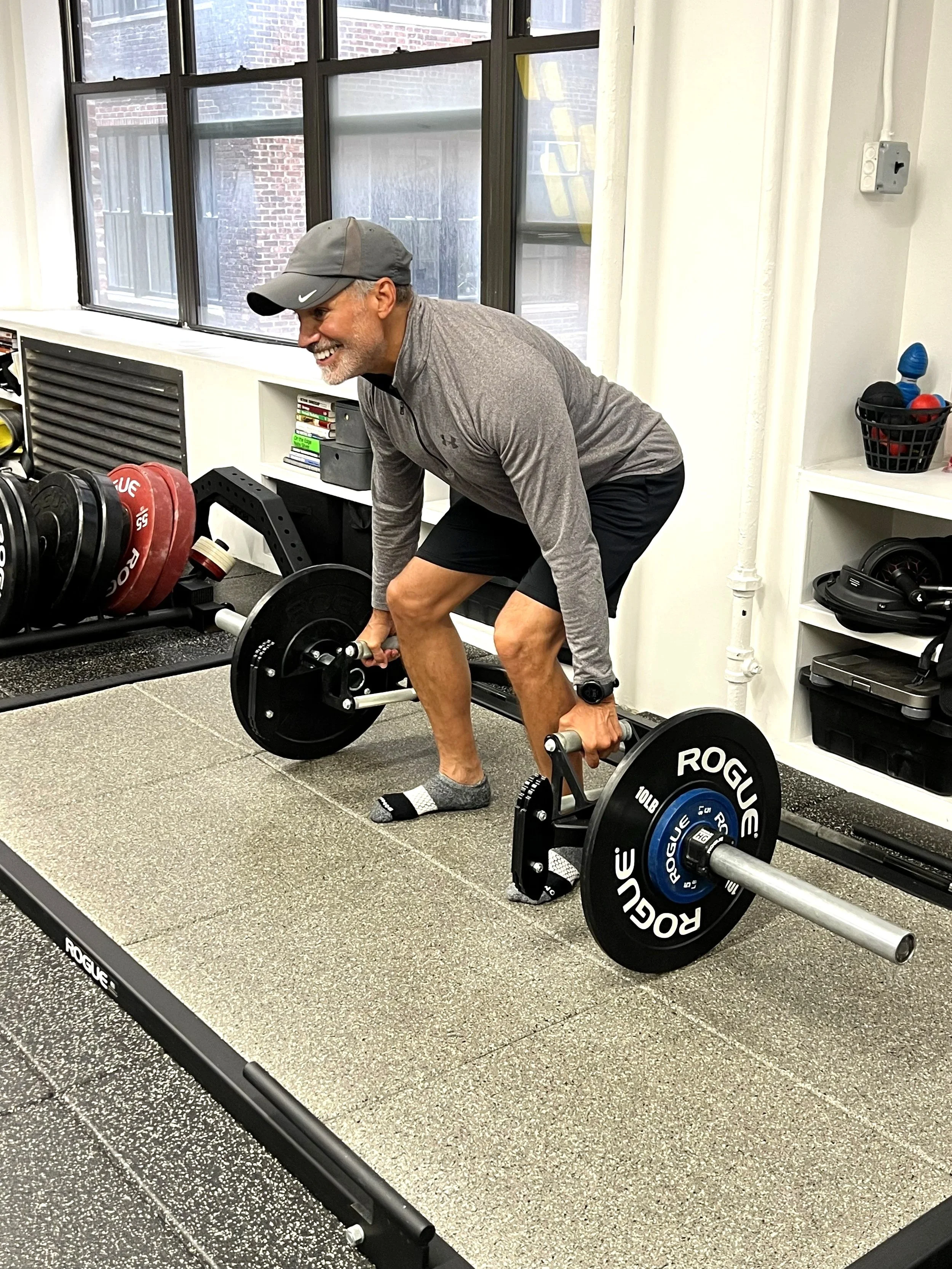
I spend a lot of time on the golf course these days, playing many of my rounds as a solo golfer joining odd numbered groups. I’m frequently paired with guys older than myself, usually between 60 and 75-years-old (I play in the mornings). I enjoy these rounds, full of stories of a lifetime of golf and years out on the course.
Most impressively, these men usually are dead-straight in their dispersion, that is to say, there really isn’t a dispersion: they always hit their target. Most of these guys are carding scores in the 80’s too. But they’re often unhappy.
Why? They can’t hit it as far as they want to. Or, “used to.”
Aging and loss of power are well documented, as is the influence of distance on your overall score and strokes gained. But what’s lost in the science is something I deal with every day, and it’s very trainable.
How well you move.
The number one thing I see with all senior golfers who complain about their distance is that they’ve lost the connection to their lower body. They don’t use their hips, or struggle to get into a good position at address. In other words, they move away from areas that could add a good 10 yards or more to their shots.
There may be good reasons for this: they may have had back surgery, neck surgery, or related health issues. Other people are otherwise healthy, just tight.
The act of not using your hips or the right muscles for the job are costing you.
Lets explore.
Reasons for You Lack of Distance and What to Do About It
I’ll start by repeating: some people have had surgeries, disc fusions, and/or any number of structural changes done to their body with a scalpel. Once you’re closer to 70, that’s not an unlikely reality for an athlete. I’m not suggesting this person do anything that violates the laws of nature. That said, I’ve been operating as a trainer, coach, and gym owner in the high performance space since 2012, and everyone can improve their movement abilities despite their injuries. I’ve taken a 72-year-old man from pre-knee replacement, to post knee-replacement sinking squats to depth and skiing again. It’s not impossible.
Poor Hip Rotation, Tight Hamstrings, Lower Back Pain.
If you have a lower back injury, tight hamstrings, or any issues involving your hips, you likely are experiencing a real lack of hip movement in your golf swing. Do you have to look like Rory or a long-driving champ with your hip movement and rotation? No. But you also know that a shot that’s “all sweep” in your upper body will likely leave you with no distance.
Instead, the important thing is to restore some basic internal and external hip rotation so you can shift your weight and create a little more downforce.
I like to start with passive and active stretches from the 90/90 seated position. This is where you’ll learn quickly what your hips are capable of and where to work. In the second image below, you’ll see I’m raising my back foot off the floor to work the internal rotation in my right hip.


Then, start a plan that involves strengthening your hamstrings (and mobilizing them). This helps relieve lower back discomfort in a majority of people. It can be as simple as using a seated hamstring curl machine at your gym paired with learning to properly hinge and flex/extend your hips. This can be done with a number of drills or lightly weighted exercises to start like Romanian deadlifts and all their variations.
With the new found strength and mobility in the hip rotators and hamstrings, it’s time to get a feel for moving laterally again.
Lateral Hip Movement
The main reason to have some lateral movement ability in your hips is to help shift the weight properly in your feet during any golf swing. If you feel like you have poor balance through your swing, lack of lateral hip movement may be why. It’s also helpful is transferring ground force to your swing. The better and more secure your feet are to the ground, the more strength goes into your swing, sending the ball farther (assuming you hit it flush, and we always do that, right?)
Lateral hip movement becomes much easier to train in the gym when you have the earlier parts of this article covered (hamstring strength, hip rotational ability, low back pain eased), so after you’ve addressed that, it’s a good idea to work side to side.
One way I like to do this is the lateral split squat, to a box. This is a great movement because you can scale it endlessly and keep changing the parameters to make it harder, easier, slower, faster, wider, etc.
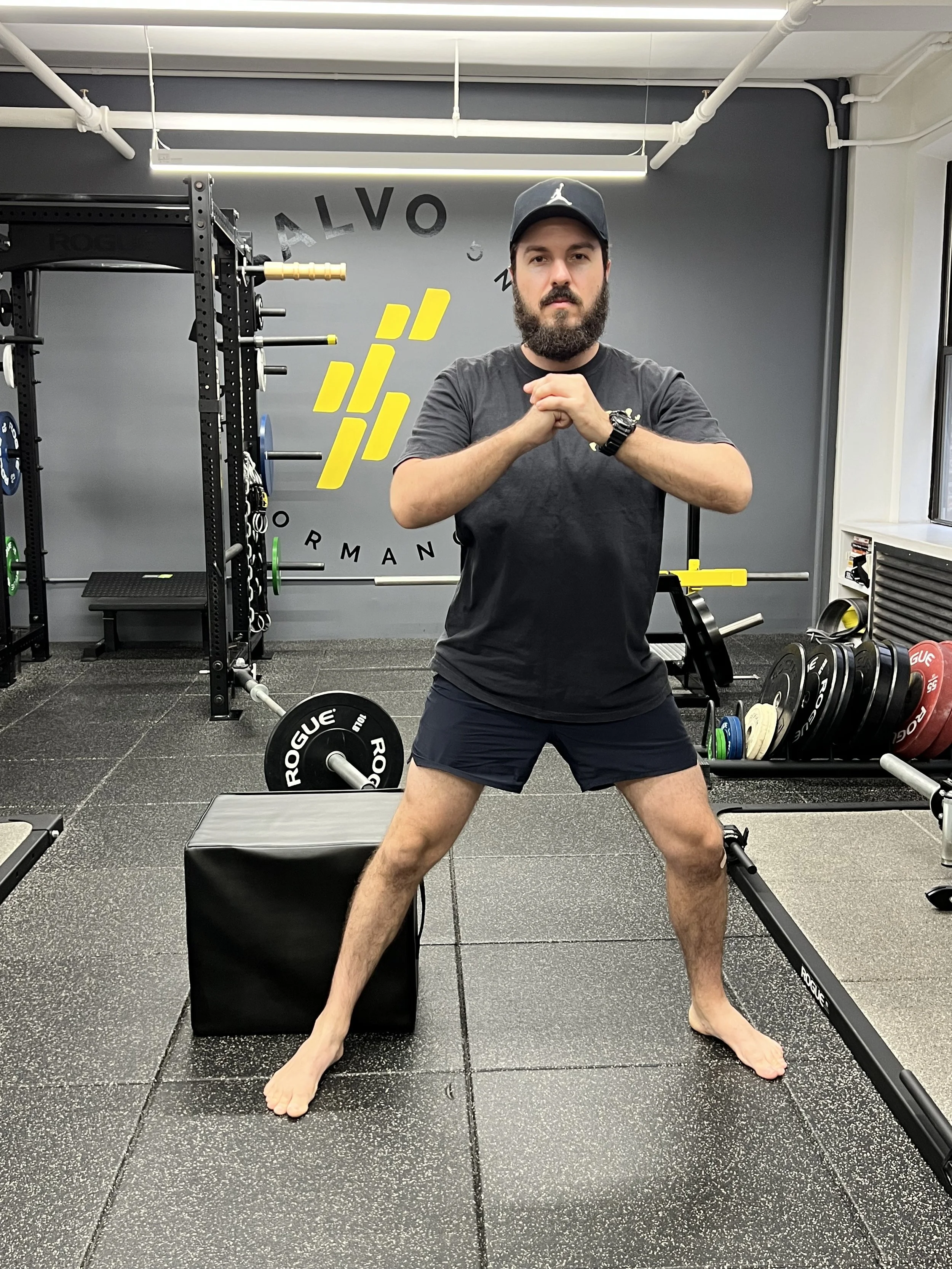
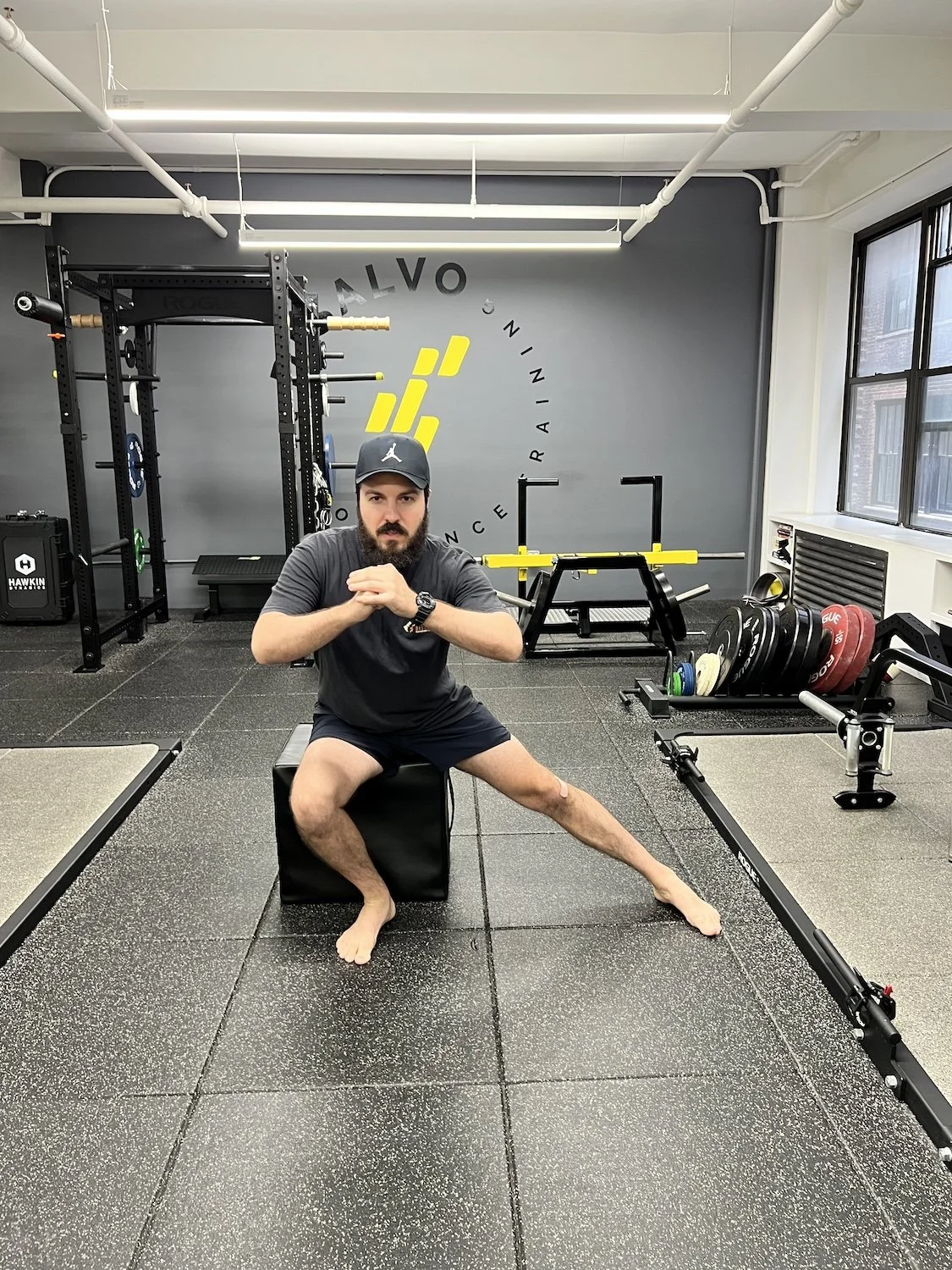
To do it, take a plyo or foam box that’s about 18” in height for most people. You may need a little taller depending on your height. Stand with one foot in the middle of the box, the other out in the open as pictured. Sit laterally to the box, trying to keep some tension as you touch down to it.
Eventually you can progress this by tapping the box and return to the start position.
You can also stay paused on the box, holding all your tension, but not fully sitting, and returning to the start position.
Conclusion
I won’t make any promises that you’ll hit some 300-yard bomb after doing these exercises, but I can say if you work on improving your overall hip mobility and lower half movement, you’ll stand to add some yardage to your shots. There’s no way you won’t.

About the Author: Mark DiSalvo, CSCS
Mark is the founder and owner of DiSalvo Performance Training. He brings over a decade of experience training clients and athletes of all backgrounds and is the strength and conditioning coach to athletes of all levels and disciplines, from youth to professional and Olympic-level.
A graduate of Northeastern University and currently working toward an M.S., he’s an NSCA Certified Strength and Conditioning Specialist (CSCS) and Sports Performance Expert. He’s also a Steve Maxwell Certified Kettlebell Instructor (Levels 1 & 2).
You can read more about him here.