Progressive Overload Doesn’t Tell the Whole Story
A well-established fact of training is that the concept of progressive overload is ultimately how you gain strength and hypertrophy in the gym.
But what about the times where progressive overload gets harder to manage and a linear progression no longer becomes possible? This is a common pain point we hear in consultations with new clients. They’ve gone to the gym for anywhere between 1-3 years, they enjoy it, they feel like they made progress…but their overall strength, physique, or lifts have generally stopped progressing.
Why?
There are a few reasons, but the two I want to focus on are matters of how you actually measure “progressive overload,” and processes happening at the cellular level of your body that involve your neurons (ultimately how you gain skill of movement), which results in progress.
Let’s explore.
Measuring
It’s an easy proposition to measure sets, reps, and weight. If you’re measuring progressive overload in a classic sense, you’re looking for one or all three to increase over a period of time. As we know, there becomes a time when the increase of any of those 3 variables becomes slower, or nearly non-existent. Why? There could be many reasons, but the theories of motor learning and our biology at a cellular level dictate that learning a new skill leads to an increase of neuron and neurotransmitter activity that ultimately is lessened as we gain the skill. We are considered “proficient” when the activity lessens, making us more efficient at what we do. Sports psychology professionals refer to this as the process of gaining “expertise.”
The thing about lifting weights is that you’re gaining expertise in lifting weights the more you do it. You’ll eventually become efficient, with rarer individuals becoming expert movers, as you practice and go to the gym more. Eventually, you’ll become proficient enough in a lift where you’re very comfortable doing the exercise, but it won’t progress in weight or repetitions unless you alter some other aspect of your physiology (your weight, body composition, etc.), or your skill (what bar do you do the exercise with? Are you really performing the exercise with a high level of skill? Can you change your intent and tempo and maintain your form and technique?).
Usually the answer to some of those above questions is “no” or “I haven’t considered that…”
These are also coincidentally, things you can “progressively” increase your skill at in an effort to “overload” the body into adaptation.
See what I did there?
Skill Acquisition
It’s a lack of skill and global understanding of what to feel, how to feel it, and more importantly, how to skillfully do the movement that can really undermine someone who is trying to add real density to their training program with no progress to show for it.
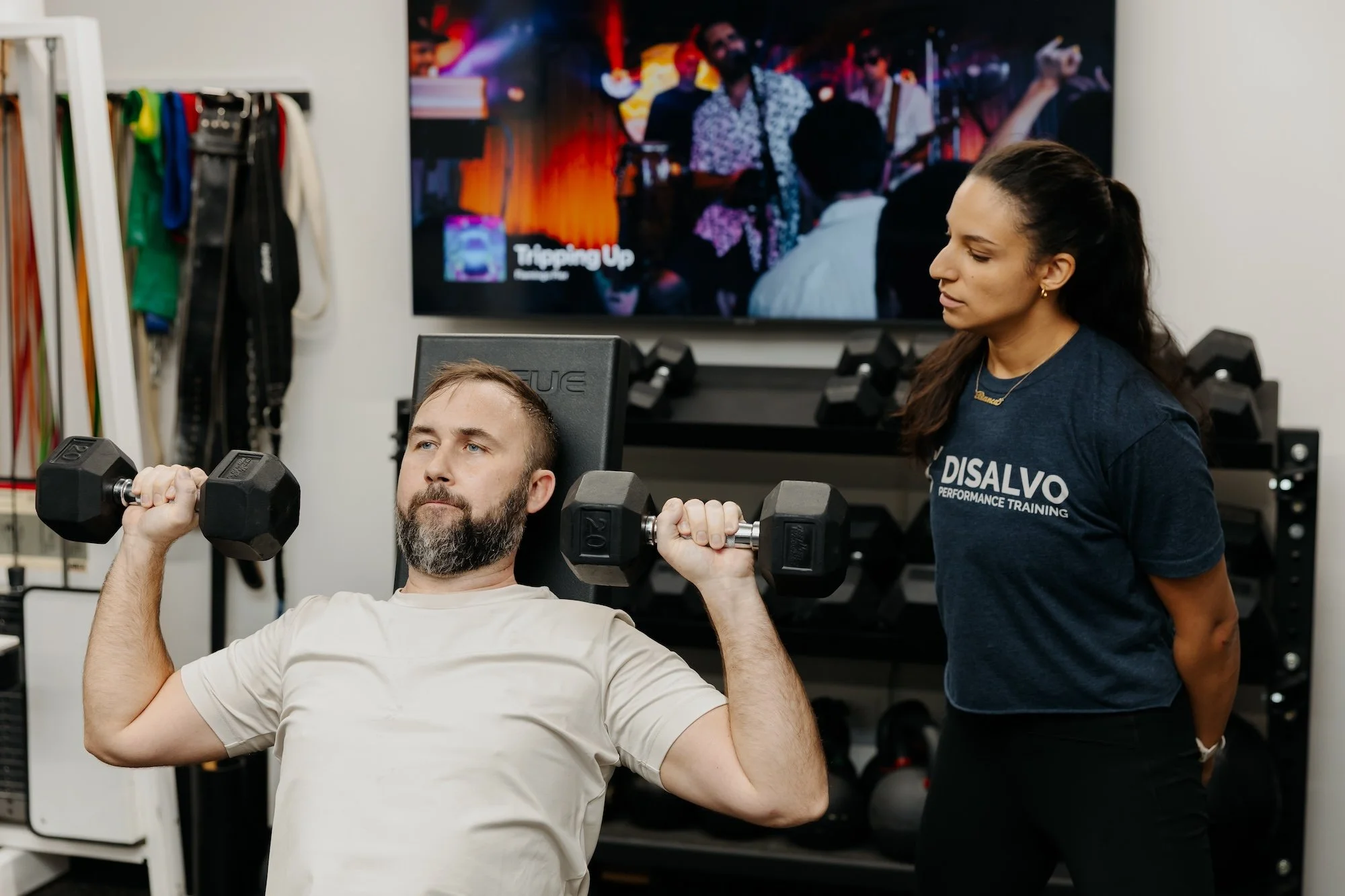
Whether you’ve thought of it this way or not, the movements and exercises you partake in at the gym require skill. It’s a bit more easy to see this in large movements like the squat, bench press, or deadlift (and even more apparent in the snatch and clean & jerk), but it can be easy to forget that simply keeping your arms from creating too much momentum (or any) in a biceps curl is a skill that helps you feel the contraction more intently, and thus, improving your ability to actually perform a biceps curl.
So if you’re stuck and have trained for the timeframe I’ve mentioned, it’s likely you never acquired the right skills to properly “overload.” So these discussions about “progressive overload” and a narrow focus on it miss the forest for the trees: progressive overload is a correlation, not always causation, of increased skill and changing physiology.
When you hit a plateau, that is a sign, or an opportunity to consider, that you’re exceeding either your body’s physiology to perform it, or your skill to perform the movement. Sometimes the answer is both.
Conclusion
Progressive overload is ultimately the concept and pattern we are looking for when we zoom out at a macro level to examine a program. Are you getting stronger? Are you getting bigger/developing your ideal body composition, and are your training program results and numbers reflecting that? It’s the driver of progress, there is very little dispute there. However, the lens with which people examine progressive overload is often incomplete or flawed and that ultimately leads to frustration.
All of that to say: if you’re not getting stronger after an appropriate length of time, then it may be time to change your body composition to support your training efforts. Similarly, it may be necessary to acknowledge other parts of skill acquisition and progressive overload: variety, quality of movement, rest intervals, and tempo. Maybe even weak links in your overall body in the form of individual muscles.
That’s why one of the simplest things you can do is to acknowledge that progressive overload is not a “Starting Strength”-like proposition: it’s complex. Complexity doesn’t have to be bad; most of what we do in life is very complex.
Enjoy your training and reach out with any questions. We’re here to help.

About the Author: Mark DiSalvo, CSCS
Mark is the founder and owner of DiSalvo Performance Training. He brings over a decade of experience training clients and athletes of all backgrounds and is the strength and conditioning coach to athletes of all levels and disciplines, from youth to professional and Olympic-level.
A graduate of Northeastern University and currently working toward an M.S., he’s an NSCA Certified Strength and Conditioning Specialist (CSCS) and Sports Performance Expert. He’s also a Steve Maxwell Certified Kettlebell Instructor (Levels 1 & 2).
You can read more about him here.