
What is RPE Training?
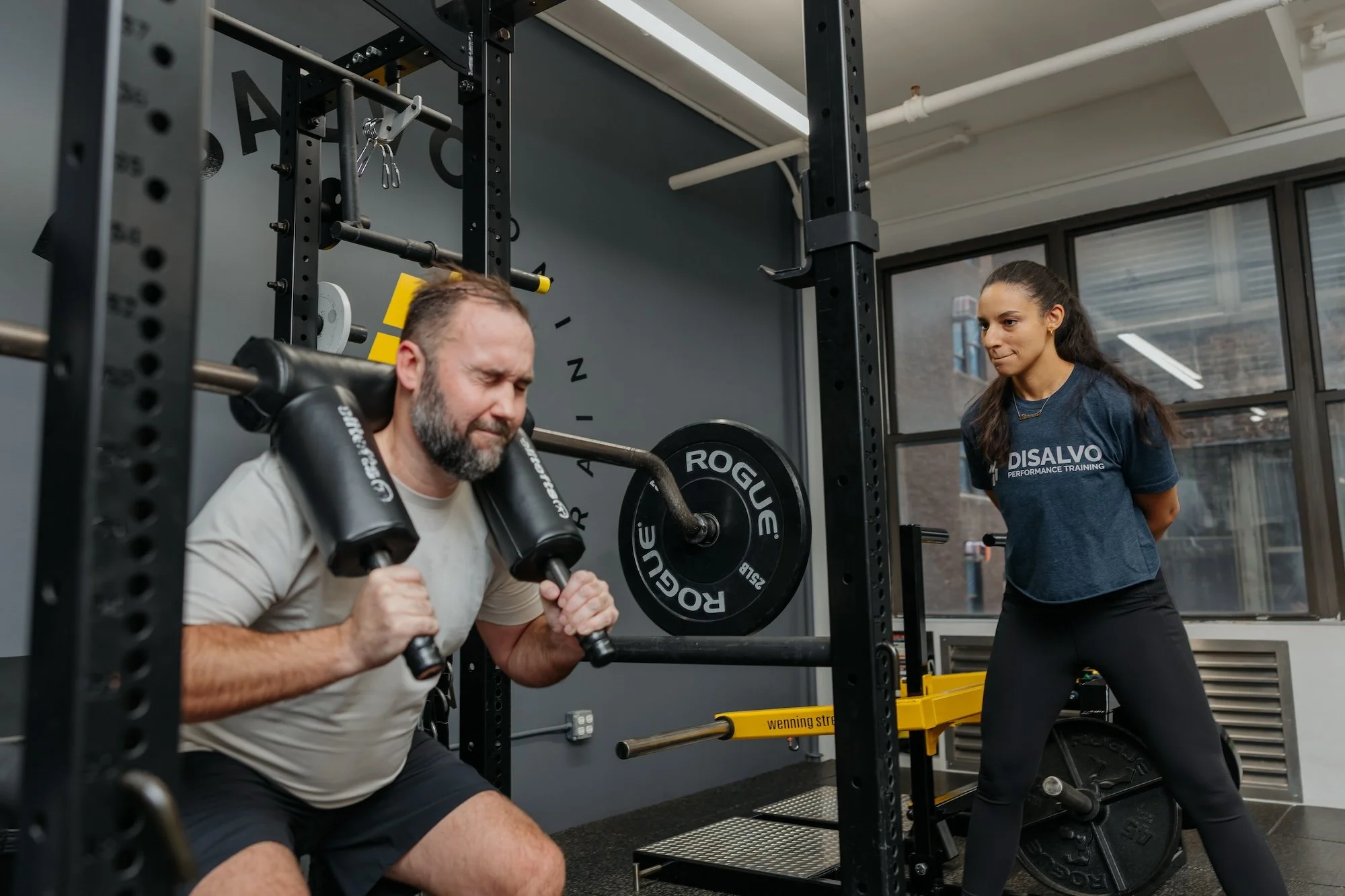
When it comes to managing your training intensity, it can be really hard to manage your effort in a way that feels useful. Sometimes, you hit the gym ready to really send it, only to leave feeling confused and under-trained, like you have more in the tank. Other times, you get to the gym with the intention of “going lighter” only to leave feeling more sore than when you started.
“RPE is completely subjective and changes from person to person.”
The way to manage your efforts and get the most out of your training is to utilize the Rate of Perceived Exertion scale (RPE).
RPE is a subjective measurement that the individual athlete uses to assess their efforts on a lift. It’s measured on a 1 to 10 scale, with 1 being something remarkably easy for you, and 10 being the hardest physical effort you’ve ever endured. If measured or calibrated correctly, you’ll only ever do something that’s an RPE 10 a few times in your life, as it’s the hardest thing you’ll ever do (think lifetime PR’s on the platform, personal best split times, rep PR’s you’ll never get near ever again).
A key consideration: notice how I said “remarkably easy FOR YOU” or “hardest physical effort YOU’VE ever endured.” This is because RPE is completely subjective and changes from person to person. The scale is dependent on you, and should evolve as you get stronger. For example, if a deadlift of 225lbs for 5 reps is an RPE 8 for you in your first year of training, then it stands to reason that same set will be an RPE 6 (maybe less) by your fourth or fifth year.
You would think something so subjective wouldn’t be effective, but it’s been shown to repeatedly get close to reality and measure up just as well, if not better in some instances, than percentage based modalities and others when studied (see further reading at the footer of this article).
When coaches use it
Coaches and trainers also use RPE as they get to know their athletes and clients better. Once we have a sense of how you move weight, how strong you are, and have some data and hard numbers on you, we are also able to evaluate what we think your RPE actually was during each set.
A good example of a way in which a coach will evaluate what RPE they think you’re working at is bar speed. It can be with the naked eye, or it can be more precise with something like a Velocity Based Training (VBT) device. I can usually tell when a client has reached an RPE 8 because it’s the first time I notice the speed of the bar change significantly by the last rep or two of a set. Usually, these changes in how fast the weight moves correlate to what I know the client will translate as an increase in their exertion to complete the set. This gives us a mutual way of checking each other.
It’s also very useful for the rare client and athlete who has a true poker face, or those people whose facial expression never changes, no matter the level of effort they put into their training. Sometimes a coach just needs to know “how hard was that?” and we need to speak a similar language.
Examples of programming it
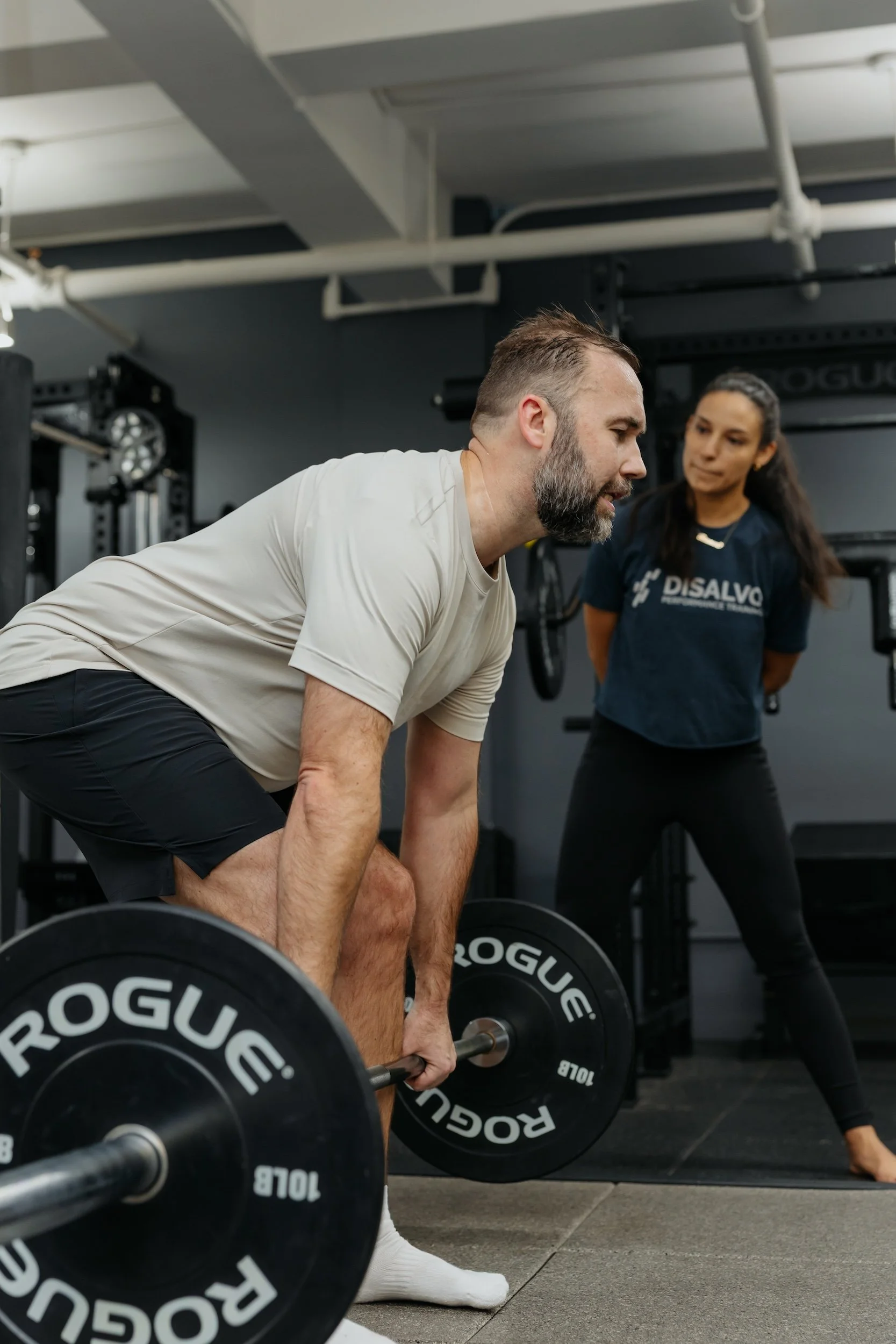
RPE isn’t just specific to an individual set and individual exercise. It helps to take a macro-level view of RPE when working on programs and planning out your training over the longer term.
For example, you may want to dose someone’s exposure to heavy weights, so you start with a low RPE on week 1, and have the client reach peak effort on Week 4. That would look like this:
Week 1: Top set should be RPE 6
Week 2: Top set should be RPE 7
Week 3: Top set should be RPE 8
Week 4: Top set should be RPE 9
Just like percentage based training, RPE can be used to manipulate training load. However, with RPE, the load is less defined and up to the athlete. This makes RPE a very good choice for strength and conditioning coaches who are training athletes who spend most of their physical hours practicing or competing in a different sport outside the weight room. For these athletes, it matters less usually how much is on the bar, and more that they’re making some type of progress.
In these instances, RPE is also useful for picking up on fatigue from sport training that doesn’t go away in the weight room. If you know an athlete’s 3RM deadlift is 400lbs and they’re suddenly telling you a 3 rep deadlift at 225lbs feels like an RPE 8, you know you’re dealing with an athlete who is under-recovered and needs to lay off the weights for the day.
However, it’s a very important consideration to not entirely dismiss actual numbers for RPE. I often use percentages to “check” myself against the RPE the athlete reports, just to make sure things are moving forward in a way that makes sense.
Mistakes
Like anything, RPE can be manipulated and misapplied. Unfortunately when this happens, it’s the athlete/client who suffers the most, as they simply are cheating themselves of progress.
Usually RPE fails for 2 reasons:
Ego
Habitual undershooting and not really knowing what it’s like to push to a 9 or 10 RPE.
When ego is at issue, the athlete usually has difficulty backing off for the day at a set that feels like an RPE 6 or 7, when that is what’s prescribed for the day.
Another example of ego getting in the way is when an athlete has an RPE 8 set of 4 reps and takes over 10 seconds between reps to complete a set. If you can’t reasonably complete an RPE 8 set of 4 with reps uninterrupted, that’s not an RPE 8 for you.
On the other hand, habitually under-shooting or sandbagging yourself is harmful to RPE because you’ll train at intensities too low to ever push meaningful progress. These athletes usually struggle with 3RM, 2RM and 1RM testing, because this requires a much more maximal exertion than they’re used to practicing.
Conclusion
Rate of Perceived Exertion has multiple layers of utility in an athlete’s training program. It shines when educating individuals on their own capacity and limits, but also has a lot of usefulness in longer term planning. Give it a shot, and if you need help, we’re happy to teach you.
Further ReadingGomes, Rodrigo L.1; Lixandrão, Manoel E.1,2; Ugrinowitsch, Carlos1; Moreira, Alexandre1; Tricoli, Valmor1; Roschel, Hamilton1,2. Session Rating of Perceived Exertion as an Efficient Tool for Individualized Resistance Training Progression. Journal of Strength and Conditioning Research 36(4):p 971-976, April 2022. | DOI: 10.1519/JSC.0000000000003568
Haddad M, Stylianides G, Djaoui L, Dellal A, Chamari K. Session-RPE Method for Training Load Monitoring: Validity, Ecological Usefulness, and Influencing Factors. Front Neurosci. 2017 Nov 2;11:612. doi: 10.3389/fnins.2017.00612. PMID: 29163016; PMCID: PMC5673663.
Morishita S, Tsubaki A, Takabayashi T, Fu JB. Relationship between the rating of perceived exertion scale and the load intensity of resistance training. Strength Cond J. 2018 Apr;40(2):94-109. doi: 10.1519/SSC.0000000000000373. PMID: 29674945; PMCID: PMC5901652.

About the Author: Mark DiSalvo, CSCS
Mark is the founder and owner of DiSalvo Performance Training. He brings over a decade of experience training clients and athletes of all backgrounds and is the strength and conditioning coach to athletes of all levels and disciplines, from youth to professional and Olympic-level.
A graduate of Northeastern University, he’s an NSCA Certified Strength and Conditioning Specialist (CSCS) and Sports Performance Expert. He’s also a Steve Maxwell Certified Kettlebell Instructor (Levels 1 & 2).
You can read more about him here.